
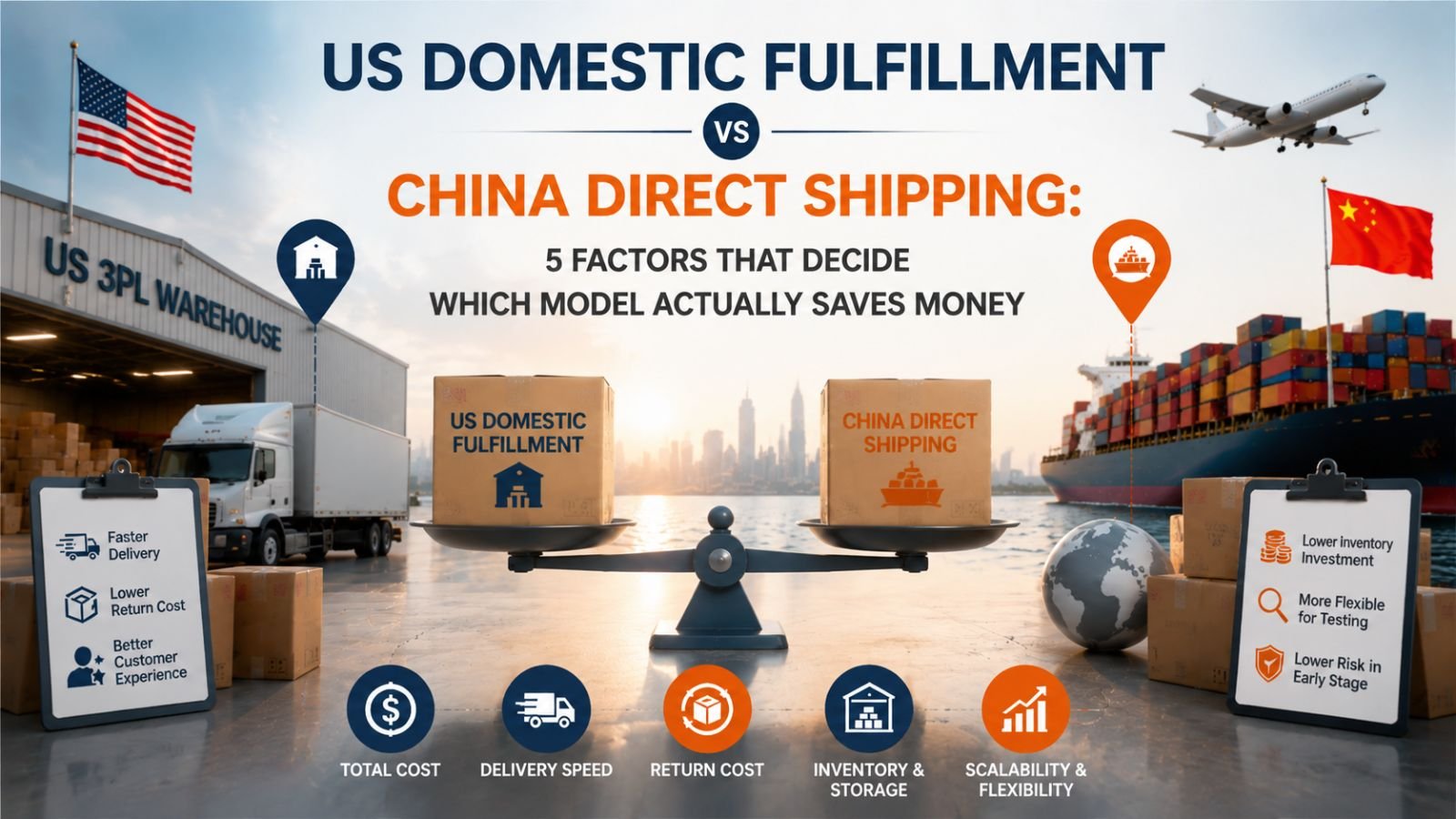
Most sellers pick a fulfillment model based on shipping cost alone. That is the wrong starting point. The real question is what the full picture looks like once you add cash flow, storage, returns, and tariff timing into the math.
China direct shipping often beats US domestic fulfillment on total landed cost for lightweight products under 2 lbs. But the break-even point shifts between $300K and $1.5M GMV depending on your product weight, delivery expectations, and how much working capital you can afford to lock up.
There is no single right answer here. The model that saves money for one brand can quietly drain another. What follows are five factors I look at when helping sellers decide, including the ones most cost calculators leave out entirely.
Does Cash Flow Matter More Than Shipping Cost?
A lot of sellers obsess over per-unit shipping rates. I understand why. It is the most visible number on the invoice. But in my experience, the sellers who make the wrong fulfillment decision are almost always optimizing the wrong variable.
China direct shipping typically locks up your capital for around 10 to 15 days from order to payout. Stocking inventory in a US warehouse can freeze that same capital for 10 to 12 weeks. For brands reinvesting into ads or new SKUs, that gap is often worth more than any per-unit shipping savings.
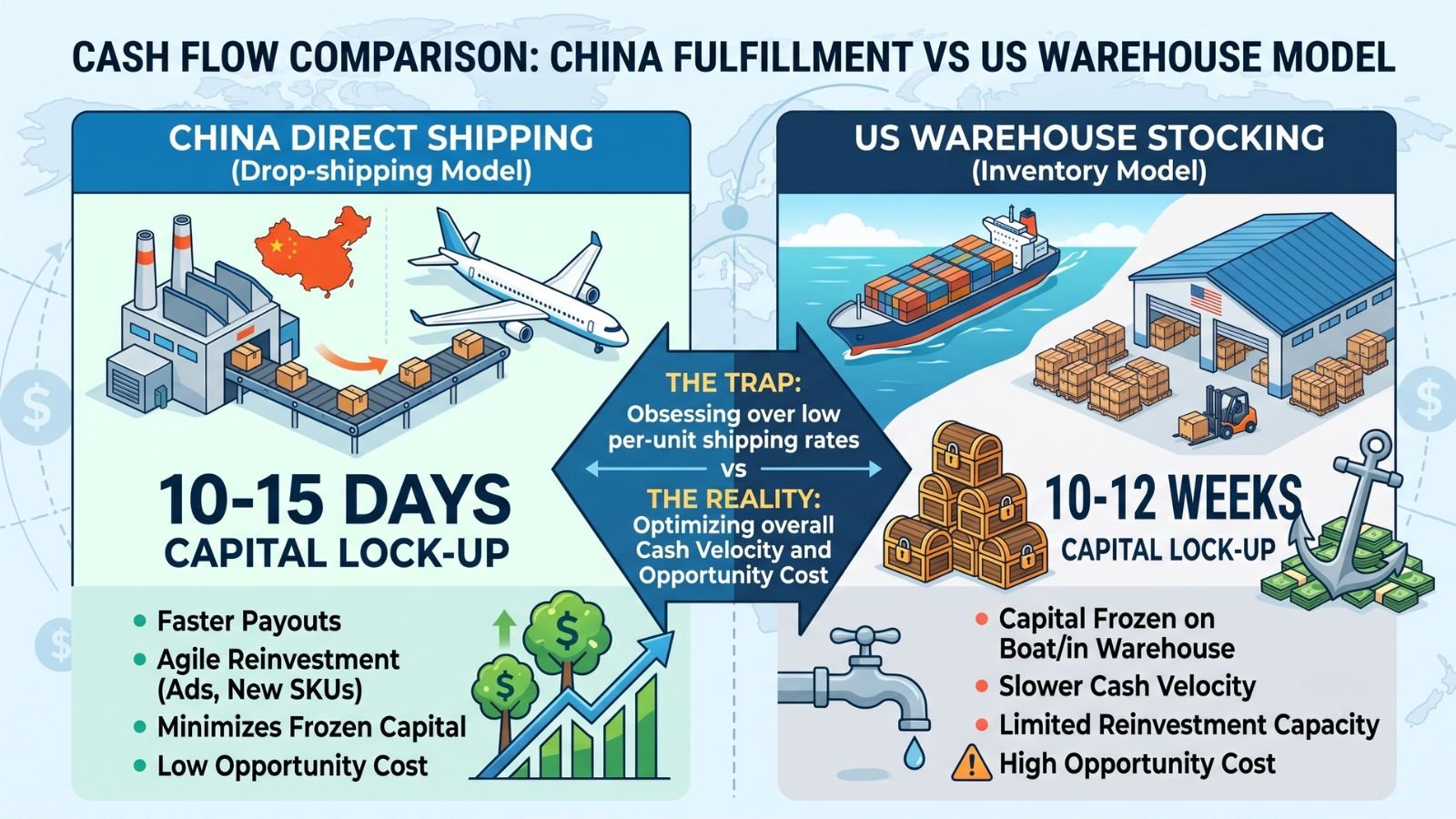
One seller I came across in a logistics forum put it this way: "12 weeks of dead capital vs like 10 days? That changes everything when you're trying to reinvest into new SKUs or run ads. Nobody ever accounts for the opportunity cost of having tens of thousands of dollars just sitting on a boat for 2 months." That quote stuck with me because it is exactly what the spreadsheets miss.
Why the Cash Flow Gap Is Bigger Than It Looks
When you ship a container to a US 3PL, here is what actually happens to your money:
| Stage | Estimated Time | Capital Status |
|---|---|---|
| Production to port | 2–3 weeks | Tied up |
| Ocean freight transit | 3–5 weeks | Tied up |
| Port clearance + receiving | 1–2 weeks | Tied up |
| Warehouse to customer | 2-5 días | Tied up |
| Payment settlement | 1-3 días | Released |
With China direct shipping, you skip most of that chain. You manufacture, fulfill per order, and collect payment in a cycle that runs in days rather than months.
This matters most when you are testing new products. One supply chain professional I spoke with made the point clearly: the fulfillment center model allowed her team to source and test more products without committing to large MOQs. That flexibility is a real financial advantage, and it does not show up on any per-unit cost comparison sheet.
The cash flow model does not win every situation. If your customers expect 2-day delivery, the 6–10 day window from China will cost you in conversion and reviews. But if you are still in the validation stage, locking up $80K–$100K in US warehouse inventory for months is an expensive way to find out a product does not work.
What Are the Five Hidden Costs Most Calculators Miss?
Most fulfillment calculators show you two numbers: domestic shipping cost versus international shipping cost. That comparison is almost useless on its own. The real cost difference lives in five places that rarely appear in those tools.
The five costs that change the math are: inbound freight to the US warehouse, receiving fees, monthly storage fees, return processing costs, and upfront duty payments. When you add all five to the US domestic model, the per-unit advantage over China direct shipping often shrinks or disappears entirely.
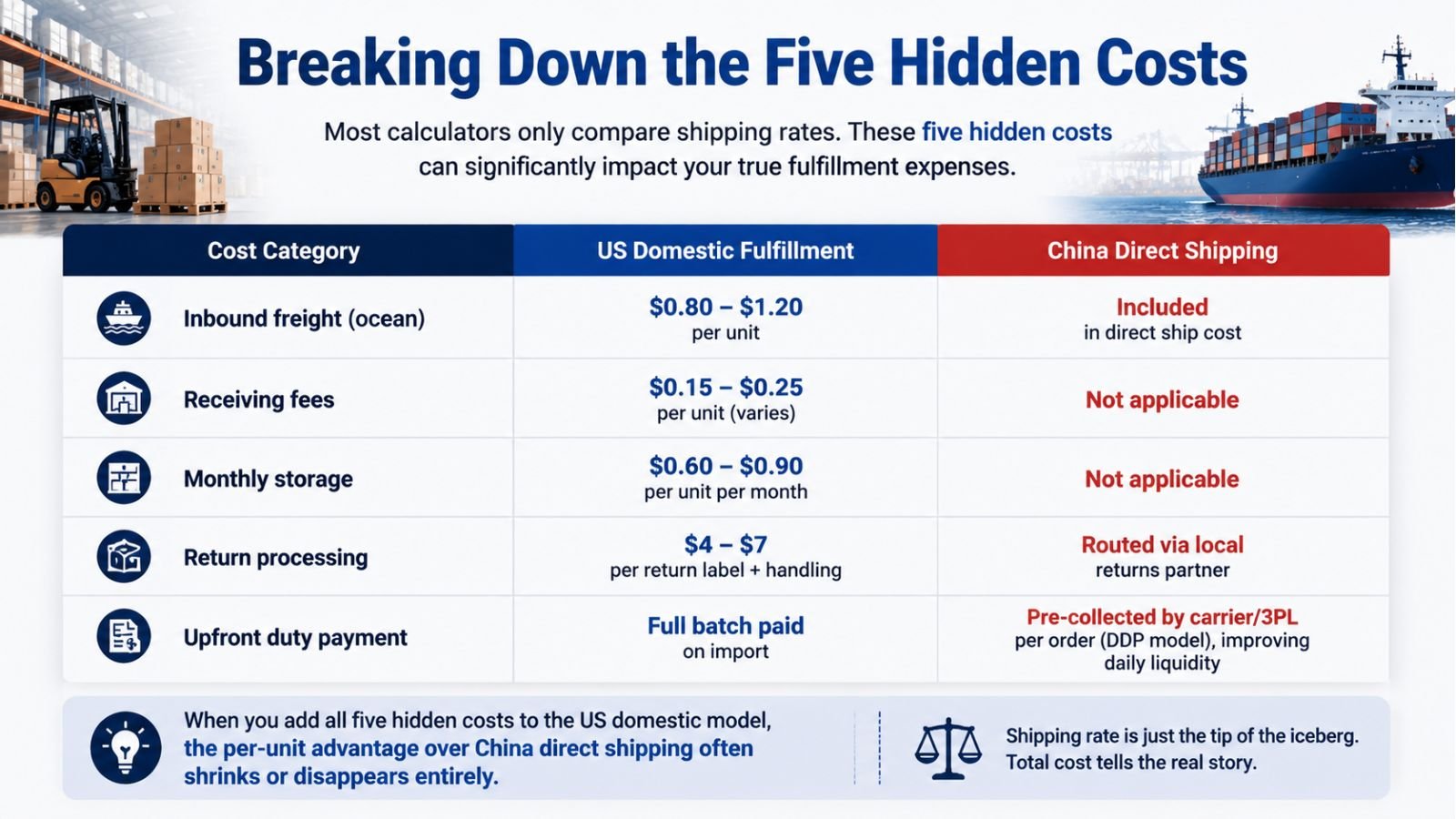
A seller I know ran a side-by-side quote from ShipBob and a local 3PL against his China fulfillment partner. The per-unit shipping rate looked better with the US 3PL at first glance. Then he added the full stack of fees. The numbers fell apart.
Breaking Down the Five Hidden Costs
| Categoría de costes | US Domestic Fulfillment | China Direct Shipping |
|---|---|---|
| Inbound freight (ocean) | $0.50–$1.50 per unit | Included in direct ship cost |
| Receiving fees | $0.10–$0.20 per unit (varies) | Not applicable |
| Monthly storage | ~$0.75 per unit per month | Not applicable |
| Return processing | $3–$8 per return label + handling | Routed via local returns partner |
| Upfront duty payment | Full batch paid on import | Pre-collected by carrier/3PL per order (DDP model), improving daily liquidity |
Inbound Freight
Most sellers calculate the cost of shipping to their customer. They forget the cost of shipping inventory to the US in the first place. Ocean freight on a full container can run $0.50–$1.50 per unit depending on product size and volume. That cost belongs in the US fulfillment model, not floating somewhere off the books.
Storage Fees
Inventory sitting in a US warehouse is not free. Monthly storage fees at most 3PLs run around $0.75 per unit, and that is before any long-term storage penalties. If you are stocking two to three months of inventory, that is $1.50 to $2.25 per unit in pure holding cost before a single order ships.
Receiving Fees
When a container arrives at a US warehouse, the 3PL charges you to unload, count, and shelve it. These fees vary widely but they are real and they add up at volume.
Return Processing
Returns in the China direct model go through a local returns partner. A customer sends the item to a US address, the partner processes it, and the item either gets resold, disposed of, or shipped back. It is not as seamless as a US warehouse return, but for most product categories it is workable. The cost difference here depends heavily on your return rate.
Upfront Duty Payment
This one is important and often misunderstood, especially right now. With US domestic fulfillment, you pay duties on the entire container when it clears customs. That is a large, upfront cash outlay. With China direct shipping, duties are typically pre-collected by your logistics partner on a per-order basis (DDP). You are not avoiding duties. You are spreading them across time, which improves cash flow even if the total is the same.
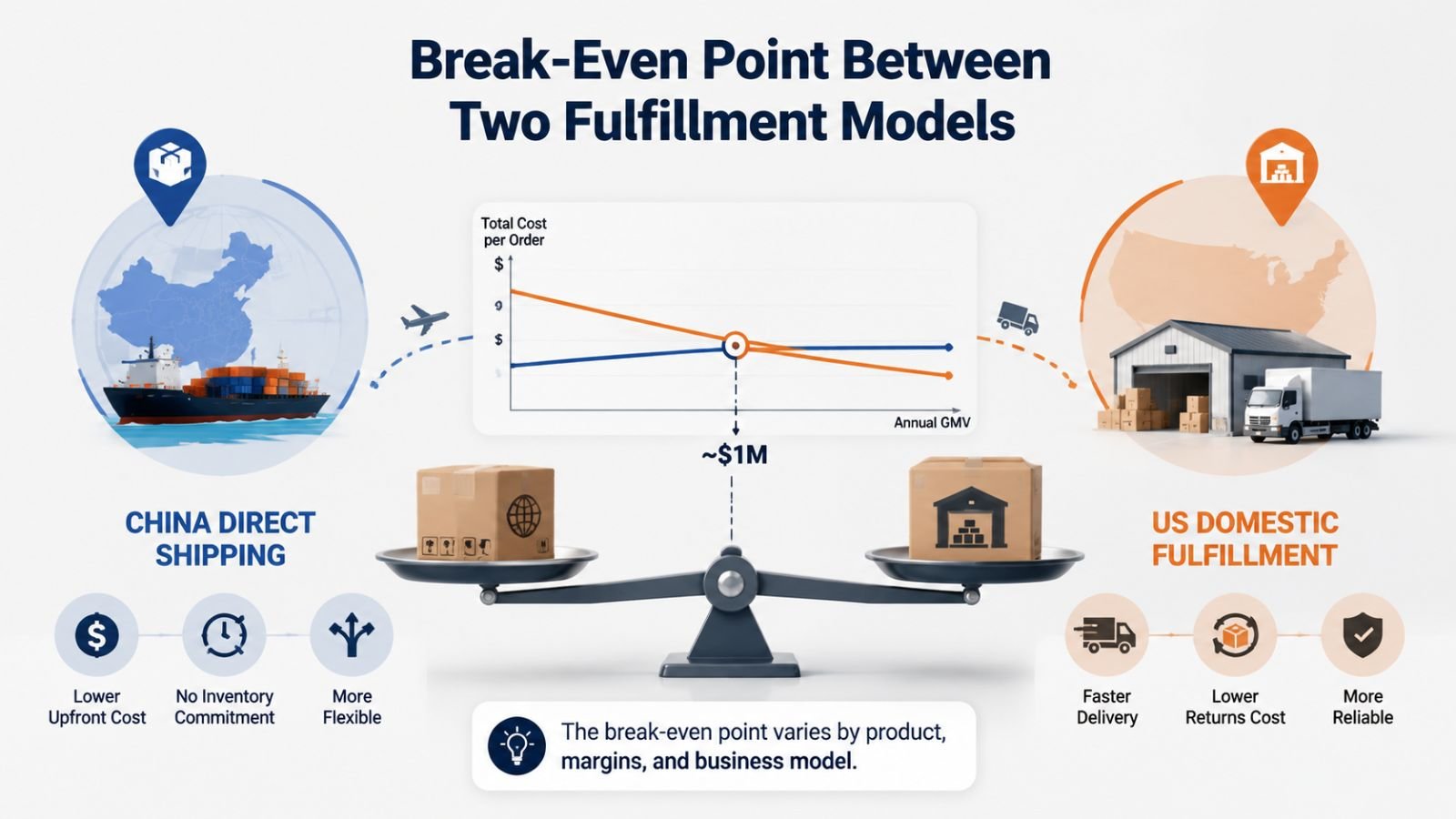
Is There a Clear Break-Even Point Between the Two Models?
This is the question I get asked most often. Sellers want a clean number. The honest answer is that the break-even range is wide, but there is a useful reference point that applies to many brands.
For most eCommerce brands, the math shifts toward US domestic fulfillment somewhere between $300K and $1.5M in annual GMV. Around $1M is a reasonable starting point for the analysis, but it is not a universal rule. Your product weight, margin, and delivery requirements all move that line.
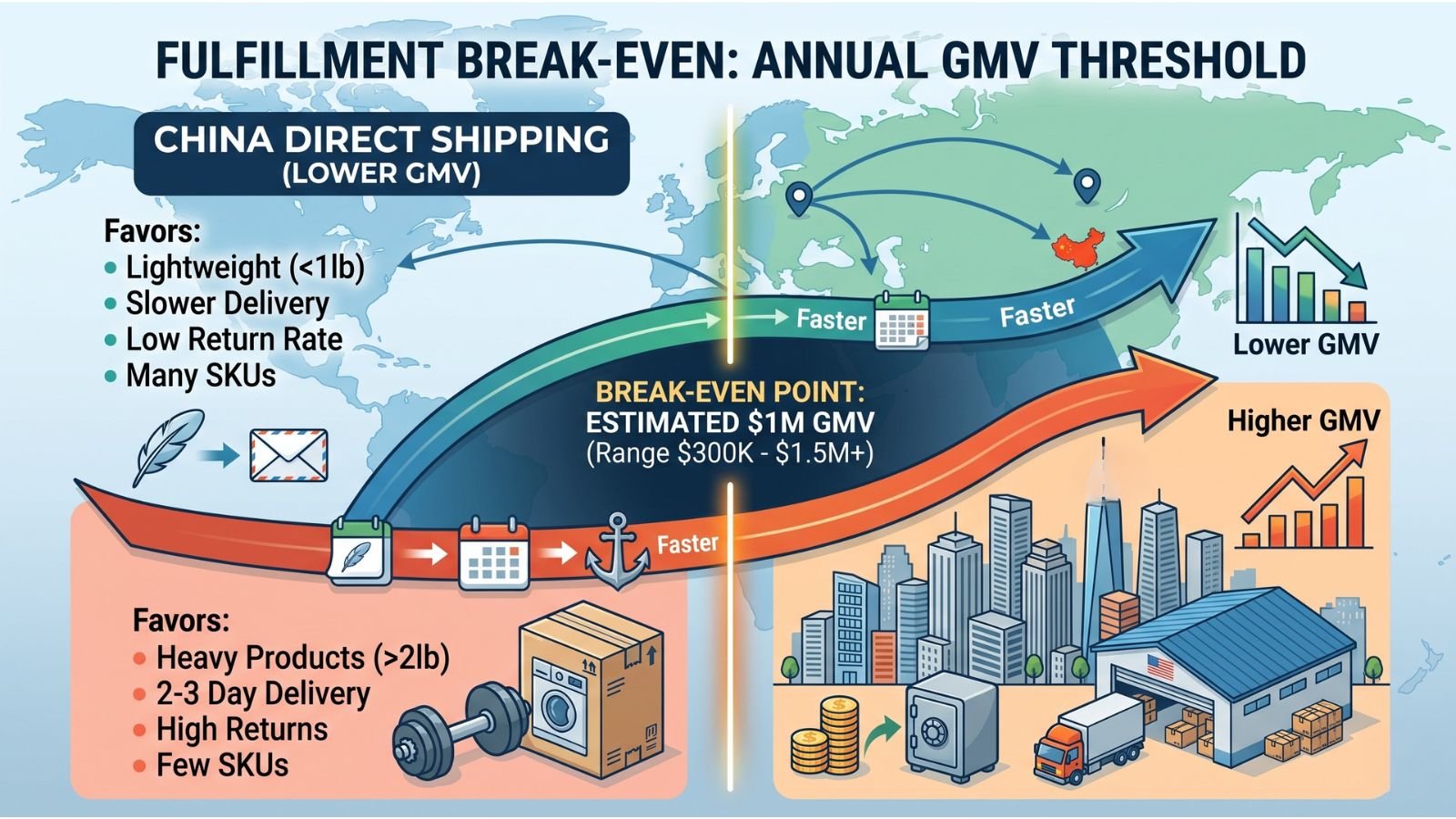
One fulfillment industry professional I spoke with put it simply: once a brand hits around $1M in annual demand from a specific market, the numbers tend to favor local warehousing. But he was quick to add that several factors can push that threshold significantly lower.
What Moves the Break-Even Line
| Factor | Pushes Break-Even Lower (favors US) | Pushes Break-Even Higher (favors China) |
|---|---|---|
| Product weight | Heavy products (>2 lbs per order) | Lightweight products (<1 lb per order) |
| Delivery expectations | Customers expect 2–3 days | Customers accept 6–10 days |
| Return rate | High return rate (>10%) | Low return rate (<5%) |
| SKU count | Few SKUs, high volume per SKU | Many SKUs, low volume per SKU |
| Working capital | Sufficient capital to stock inventory | Limited capital, needs fast turnover |
| Order volume consistency | Predictable, steady demand | Seasonal or unpredictable demand |
The $1M figure is a useful starting point for a conversation, not a finish line. I have seen brands at $400K GMV where US fulfillment made clear sense because they sold heavy items with a high return rate. I have also seen brands at $2M GMV still running profitably on China direct because their products were tiny, light, and low return.
Run your own numbers with the full cost stack before making any switch.
Does the End of De Minimis Kill the China Direct Model?
This is the question that has been coming up constantly since early 2025. On May 2, 2025, de minimis treatment for goods originating from China and Hong Kong ended in the United States. Packages that previously entered duty-free under the $800 threshold are now subject to full tariff collection.
De minimis ending does not automatically make China direct shipping unprofitable. It removes a cost advantage, but it does not flip the entire equation. For many SKUs, especially lightweight, high-margin products, China direct shipping can still work once you run the full landed-cost math including the new duty structure.
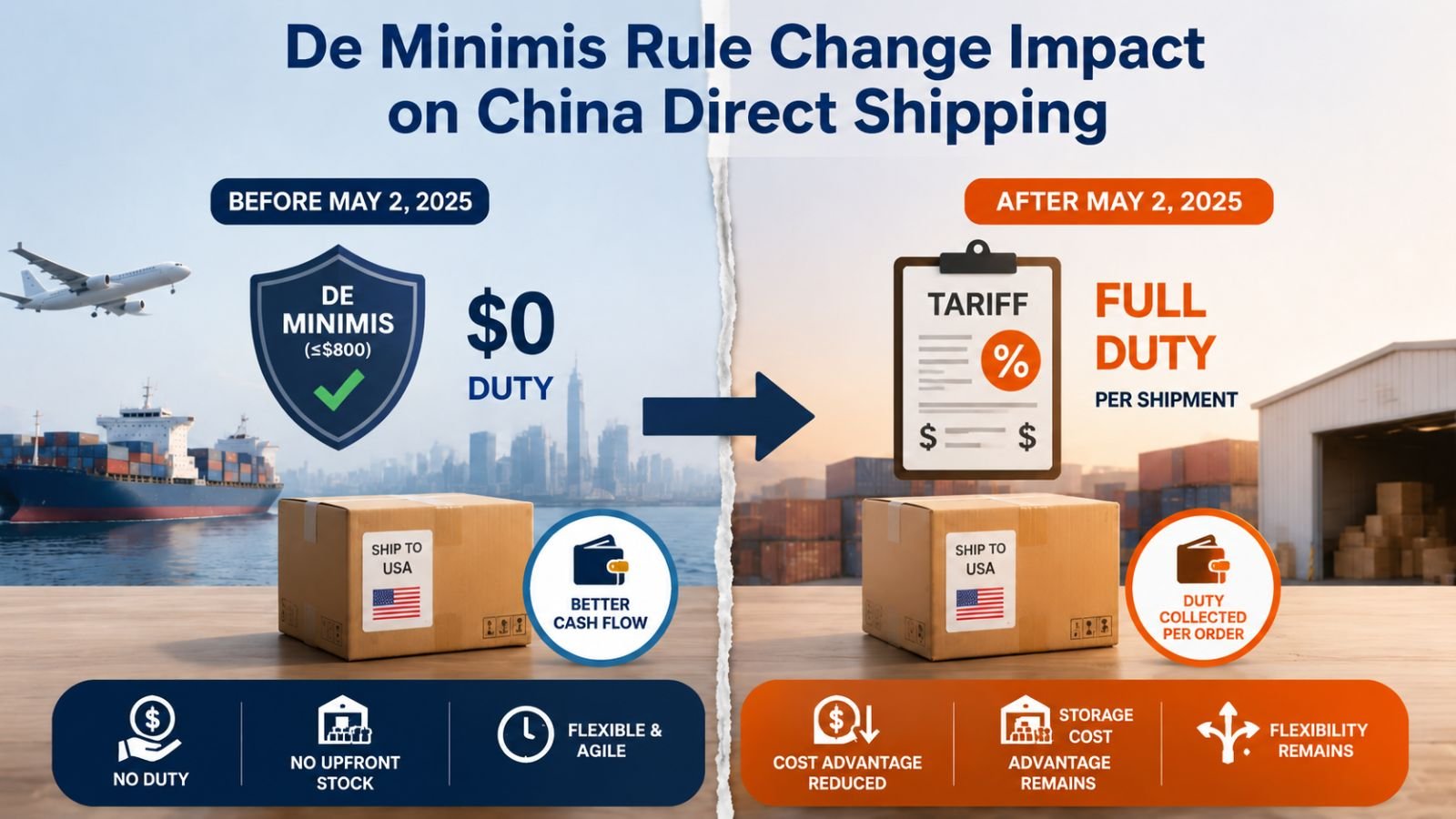
The key insight here is one I keep coming back to: duties were never being avoided under de minimis. They were being avoided on a technicality. Now that the technicality is gone, the question is how the duty payment timing compares between models.
De Minimis Ending: What Actually Changed
| Factor | Before May 2, 2025 | After May 2, 2025 |
|---|---|---|
| Duty on China direct shipments | $0 (de minimis exemption) | Full tariff rate per shipment |
| Duty on US warehouse imports | Full tariff rate on container | Full tariff rate on container |
| Duty payment timing (China direct) | Not applicable | Pre-collected by carrier at fulfillment (DDP) |
| Duty payment timing (US warehouse) | Paid in full at container clearance | Paid in full at container clearance |
| Cash flow advantage (China direct) | Large (no duty + no upfront stock) | Moderate (per-order duty, no upfront stock) |
The China direct model lost a meaningful cost advantage. That is true. But it did not lose its cash flow advantage, its storage cost advantage, or its flexibility advantage. For lightweight, high-margin SKUs where the duty amount per unit is manageable, the model can still pencil out.
The brands that should reconsider China direct shipping after this change are those with low margins, heavy products, or tariff rates high enough to wipe out any other savings. For everyone else, I recommend doing a fresh landed-cost calculation with the actual tariff rate included before making a major fulfillment change.
Is Hybrid Fulfillment the Most Practical Way to Scale?
Most of the experienced operators I talk to do not choose one model and stick with it forever. They treat fulfillment as something that evolves with the business. And the pattern I see working most consistently is a hybrid approach.
The most practical scaling strategy for most eCommerce brands is to test new products with China direct shipping, then move proven winners to US fulfillment for speed. This keeps early-stage risk low while allowing the business to improve delivery performance as products gain traction.
One e-commerce operator summarized it better than I could: "Best move is hybrid — test with China, then move winning products to a US 3PL for speed. Keeps risk low without killing margins." That is exactly the framework I recommend to most brands I work with.
How the Hybrid Model Works in Practice
| Phase | Model | Goal |
|---|---|---|
| Phase 1: Product testing | China direct shipping | Validate demand with minimal upfront investment |
| Phase 2: Early scaling | China direct + small US buffer stock | Improve delivery speed for top SKUs |
| Phase 3: Proven growth | US 3PL for winners, China for new SKUs | Optimize speed and cost by product maturity |
| Phase 4: Mature operations | Primarily US fulfillment, China as backup | Maximum delivery performance and reliability |
Why China Direct Works for Testing
When you are validating a new product, you do not know yet if it will sell. Sending a container to a US warehouse before you have proof of demand means tying up capital in inventory that might sit for months. Order fulfillment from China lets you fulfill real orders with real customers before making that commitment.
When to Move a Product to US Fulfillment
Once a product clears around $1M in annual GMV, or once customer feedback consistently flags delivery speed as a friction point, it is usually time to bring that SKU into US stock. The economics shift, and the operational benefit of faster delivery starts to justify the additional inventory investment.
China as a Permanent Backup
Even after a brand moves its core inventory to a US warehouse, keeping China direct as a backup has value. If a product goes viral unexpectedly, if US stock runs out, or if a natural disaster disrupts a warehouse, the ability to fulfill directly from China buys time. It is not a perfect solution, but it is a real safety net.
The hybrid model is not the most elegant answer. It requires managing two fulfillment pipelines at once. But it is the most honest reflection of how real businesses grow, and it avoids the trap of over-committing to one model before the data supports it.
Conclusión
The right fulfillment model depends on your product weight, cash position, delivery requirements, and where your business sits on the growth curve. Run the full cost stack, not just the shipping line, and let the numbers tell you when to switch.


 English
 Spanish
 Portuguese
 Russian
 German
 Polish