
Update — July 8, 2026: CPSC started the eFiling system on July 8, 2026. But CPSC also said that eFiling data is not yet required for customs clearance. Your shipments will not be rejected just because eFiling data is missing. Product compliance rules have not changed. You still need valid CPC/GCC certificates and safety tests. CPSC can still inspect and detain products at any time. We still suggest that you submit eFiling data on your own, because it can reduce your chance of being inspected. See Section V for details.
You sell to U.S. customers through dropshipping, direct-from-supplier, or 3PL fulfillment. The CPSC eFiling rule affects how your shipments clear U.S. customs. The rule started on July 8, 2026. It does not add new product safety rules. It sets up an electronic system for filing compliance data. Right now, this system is live, but it is not yet required for customs release.
This guide explains what the CPSC eFiling rule is. It covers which products are affected, the two filing methods, and what you should do this week.
Key Takeaways
- Start date: July 8, 2026 (January 8, 2027 for Foreign Trade Zone goods)
- Current status: The eFiling system is live. Filing is encouraged, but it is not yet required for customs release. Product compliance rules are unchanged.
- Who is affected: Anyone who imports products that already need a CPC or GCC certificate. This includes low-value shipments.
- No de minimis exemption: The Section 321 / $800 exemption covers tariffs only. It does not exempt you from CPSC rules.
- Two filing methods: Full Data Filing (7 elements per entry) or Reference Filing (3 IDs after one-time registration)
- Your role as a dropshipper: You are most likely the Importer of Record. Not your supplier. Not your fulfillment partner.
What Is CPSC?
CPSC stands for the Consumer Product Safety Commission. It is a U.S. federal agency. Its job is to protect people from consumer products that can cause harm. CPSC makes safety rules. It also enforces these rules for imported and domestic goods.
I. The CPSC eFiling Rule: What Actually Changes
1. This is not a new certification requirement.
The CPSC eFiling rule does not add any new product certification rules. It sets up an electronic system. Importers can use this system to send compliance data through the U.S. customs system (ACE) at clearance. As of July 8, 2026, this system is live. But it is not yet a required step for customs release. Product compliance rules (CPC/GCC certificates, safety tests) still apply in full, whether you use eFiling or not.
2. Purpose of the rule.
The rule helps CPSC check product risk faster. It speeds up clearance for compliant goods. It also lets CPSC focus inspections on high-risk shipments.
II. Scope: Which Products Are Affected
Product Scope
The CPSC eFiling rule covers all consumer products that already need a Certificate of Compliance. The main categories are:
Children's products (requiring a CPC — Children's Product Certificate):
- Toys
- Children's clothing and footwear
- Child safety seats
- Strollers
- Cribs
- Children's vehicles
- Children's furniture
- Similar items
General consumer products (requiring a GCC — General Certificate of Conformity):
- Household appliances
- Rugs and floor mats
- Mattresses
- Bicycles and bicycle helmets
- Lawn mowers
- Batteries
- Similar items
Not sure what CPC and GCC mean? See our CPC vs GCC explainer to learn which certificate your products need and how to get one.
For the full list of categories and HTS customs codes, see the official CPSC HTS guidance document (PDF).
Note: This document may not include every high-risk HTS code. You can use it as a starting point, but not as a complete list.
To check whether your specific product needs a certificate, use the official CPSC Regulatory Robot tool.
Clearance Methods
The CPSC eFiling rule applies to all clearance methods. There is no exception based on shipping method, carrier, or shipment value. (See the FAQ on de minimis below.)
III. Two eFiling Methods Explained
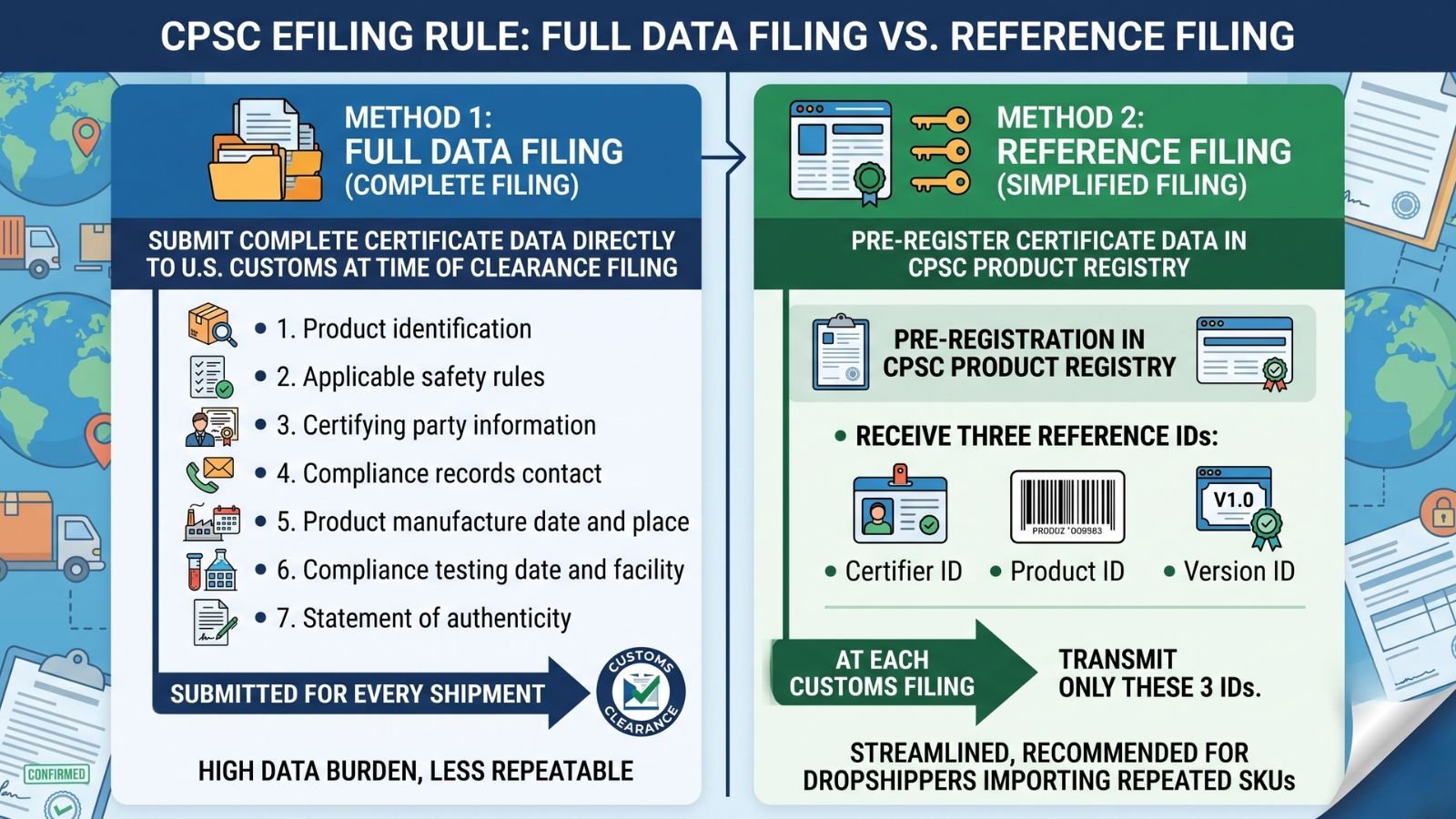
Method 1: Full Data Filing (Complete Filing)
You submit the full certificate data to U.S. Customs at clearance. The data has seven parts:
- Product identification
- Applicable safety rules
- Certifying party information
- Compliance records contact
- Product manufacture date and place of manufacture
- Compliance testing date and testing facility
- Statement of authenticity and compliance
Method 2: Reference Filing (Simplified Filing)
First, you register your certificate data in the CPSC Product Registry. After you register, you get three IDs:
- Certifier ID — identifies the certifying party
- Product ID — identifies the specific product
- Version ID — identifies the specific version of the product certificate
At each customs filing, you send only these three IDs. You do not need to send the full data set every time. This works well for dropshippers who import the same SKUs over and over. This pattern fits most dropshipping models.
IV. How to Prepare
Here is what you should do before you file. The steps depend on which method you choose:
For Full Data Filing
- Check your products. Find out which SKUs need CPSC eFiling. Do the required tests early. Get valid CPC or GCC certificates.
- Gather all the required electronic data for each product. Keep it ready to send.
- Pre-register with your logistics provider. Many logistics providers now offer this feature. You can check with your fulfillment partner if they support CPSC eFiling pre-registration. After you register your data in their system, you do not need to send documents for every order.
For Reference Filing
- Check your products. Find out which SKUs need CPSC eFiling. Do the required tests early. Get valid CPC or GCC certificates.
- Register your products in the CPSC Product Registry before you ship. Save the three IDs you get back (Certifier ID, Product ID, Version ID). Register here: CPSC Product Registry.
V. Important Reminder: Current Enforcement Status (as of July 8, 2026)
CPSC started the eFiling system on July 8, 2026. But CPSC also said that eFiling data is not yet required for customs clearance. Your shipments will not be rejected just because eFiling data is missing.
However, this change does not remove any of your compliance duties:
- Product compliance rules still fully apply. Items under CPSC rules still need valid CPC/GCC certificates and test reports. The change only affects the electronic filing step.
- CPSC still encourages eFiling data. Complete and accurate data improves your filing quality. It can also lower your chance of extra inspections.
- CPSC keeps full enforcement power. CPSC can still ask CBP to inspect, detain, sample, refuse, seize, recall, or fine any shipment.
- If your shipment is inspected, you must still show compliance documents. This includes test reports and CPC/GCC certificates. If you cannot provide valid proof, your goods may be detained, returned, or face other enforcement actions.
- CPSC may tighten the rules later. The current "encouraged but not required" status can change.
Our suggestion: Prepare complete, valid test reports and CPC/GCC certificates early. If possible, register your data with your fulfillment partner. This makes future electronic filing faster. Keep watching CPSC policy updates so your products stay compliant.
VI. Frequently Asked Questions
Q1: Can I avoid the new rule by shipping before July 8, 2026?
Only if your goods clear U.S. customs entry before that date. Goods still in transit on July 8, or held at port for entry filing on or after July 8, still fall under the eFiling rule.
Q2: Is there a de minimis exemption for low-value shipments?
No. The CPSC eFiling rule applies to all shipment values. The Section 321 / $800 exemption only covers tariffs. It has never exempted shipments from CPSC safety rules. The new eFiling system makes this easier to enforce for low-value shipments too.
Q3: Who is responsible for filing — me, my supplier, or my fulfillment partner?
The Importer of Record (IOR) is responsible. In most cases, that is you, the dropshipper. Logistics providers can send data for you. But they cannot create certificates. They also cannot guarantee the data is correct.
Q4: What if my supplier cannot or will not provide CPC/GCC data?
That SKU cannot ship until you have a valid certificate. You have four options. You can switch to a supplier who already has one. You can change to a product category that is not regulated. You can pre-stock your goods in a U.S. warehouse. Or you can work with DragonFulfill to get the certificate on your own (you pay the testing and certification fees).
Q5: What happens if my shipment has missing or incorrect eFiling data at entry?
As of July 8, 2026, missing eFiling data alone will not trigger a customs hold. But it may raise your chance of inspection. If CPSC inspects your shipment, you must still show valid CPC/GCC certificates and test reports on the spot. If you cannot, your goods may be detained, returned, or face other actions. All costs fall on the Importer of Record.
Q6: Is eFiling mandatory starting July 8, 2026?
No. As of July 8, 2026, CPSC started the eFiling system. But CPSC has not made eFiling data a required step for customs clearance. Shipments without eFiling data will not be rejected automatically. That said, all product compliance rules (CPC/GCC certificates, safety tests) still apply in full. CPSC also keeps full enforcement power. We still suggest that you submit eFiling data on your own, because it can lower your chance of inspection.
How DragonFulfill Supports Dropshippers with CPC Compliance
If the situations above sound like yours, here is how DragonFulfill can help.
For dropshipping clients, the path to CPC/GCC compliance depends on two things. First, your supplier relationship. Second, whether each product already has a certificate. DragonFulfill helps with three common situations:
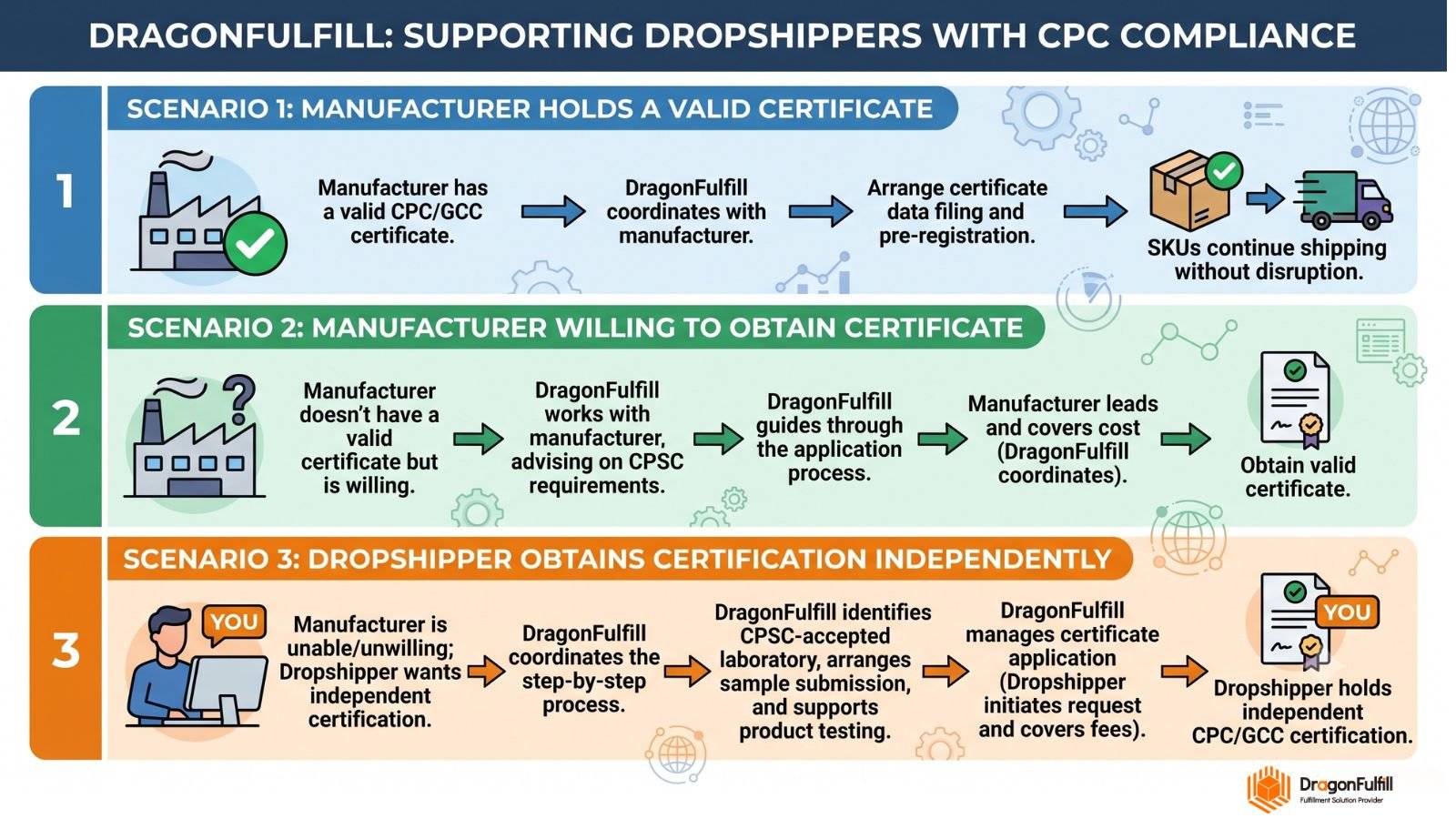
1. The manufacturer already has a valid certificate.
DragonFulfill will coordinate with the manufacturer. We will arrange the certificate data filing and pre-register it in our system. Your SKUs can keep shipping without disruption.
2. The manufacturer does not have a valid certificate, but is willing to get one.
DragonFulfill will work with the manufacturer. We will explain CPSC rules and guide them through the application. The manufacturer leads the process and usually pays the cost. DragonFulfill helps coordinate.
3. The manufacturer cannot or will not apply. You, the dropshipper, want to get the certificate on your own.
DragonFulfill can coordinate the whole process for you. We will find a CPSC-accepted lab, send samples, support testing, and manage the application. You start the request and pay the testing and certification fees.
Not sure where your products stand? Contact our team. We can audit your catalog and map out the right compliance path for your store.

 English
 Spanish
 Portuguese
 Russian
 German
 Polish