
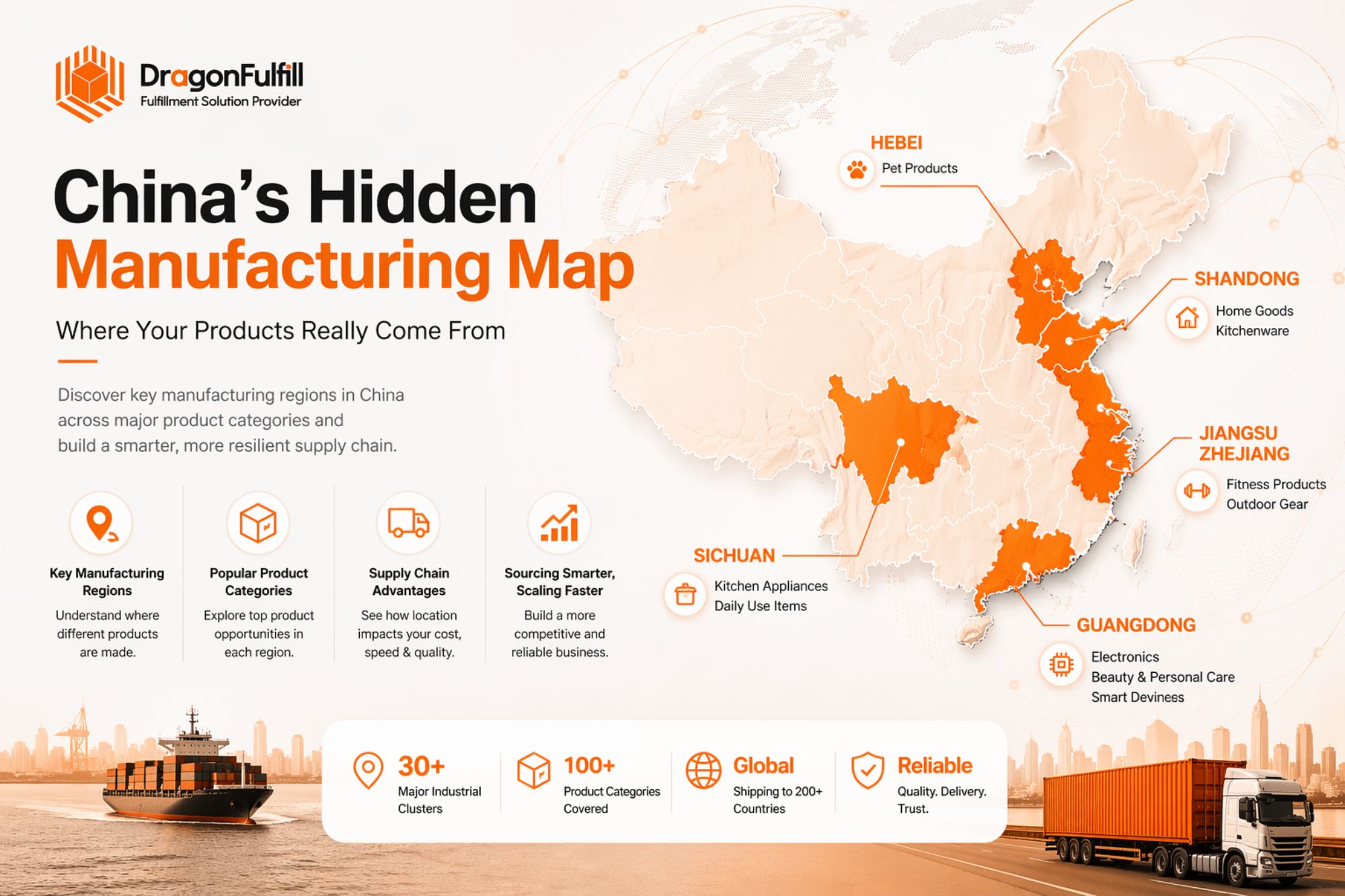
China's foreign trade reached RMB 45.47 trillion in 2025 (+3.8%), with exports alone hitting RMB 26.99 trillion (~$3.78 trillion, +6.1%). Both are new records. Roughly three-quarters of that volume flows from a handful of manufacturing provinces (China Customs / GAC, January 2026). Most published sourcing guides still use data from 2022–2023 and treat China as one big factory floor. It isn't.
This 2026 update covers what those guides miss: the high-end clusters that took shape between 2024 and 2026, including NEV cities now producing nearly 75% of the world's electric vehicles, the lithium battery belt, solar capitals, and semiconductor fabs, alongside the traditional clusters every seller already knows. Every statistic below is checked against 2024–2025 data from CAAM, MIIT, IEA, SNE Research, WEF, and company annual reports.
Why China Isn't One Factory: The Cluster Model
China doesn't make things in one giant factory. It makes them in industrial clusters: towns and cities where almost everyone in the same product category sets up shop together. The local suppliers, tooling shops, logistics providers, and skilled workers are all within driving distance. Detroit's old automotive corridor is the closest U.S. analogy. China has built dozens of these, and each one has a category specialization that generalist regions simply can't match.
Five macro clusters dominate the map. The Yangtze River Delta (YRD) leads on exports, anchored by Shanghai, Suzhou, and Yiwu (CCTV Finance, February 2026). The Pearl River Delta (PRD) is the largest single-province trader, driven by Shenzhen electronics and Guangzhou apparel (GAC Guangdong Sub-Administration, 2026). The Bohai Economic Rim (Beijing, Tianjin, Shandong) specializes in heavy industry, smart appliances, and R&D. The Western Industrial Belt (Chengdu–Chongqing–Xi'an) is the inland laptop and EV hub (Xinhua, January 2026). And Coastal Light Industry (Fujian + Shandong) rounds out the picture with footwear, appliances, and emerging green-tech capacity. Together, the top four clusters account for roughly 80% of China's exports and about 12% of global trade (China Customs / GAC, 2025).
Why an update matters now: most published guides stop at 2023 data. Between 2024 and 2026, China crossed several thresholds that reshaped the map. NEV market penetration passed 50%. Polysilicon dominance surpassed 93%. Big Fund III injected $47.5 billion into semiconductors. The categories that matter have changed.
The Traditional Map: 5 Manufacturing Clusters
For each cluster: the core cities, what they make, and what cross-border sellers need to know.
Pearl River Delta (Guangdong): Electronics, Toys & Apparel
The PRD is the most export-oriented manufacturing region in China. Shenzhen is its electronics capital, home to Huawei, DJI, BYD HQ, ZTE, and Tencent. The Huaqiangbei components district and Bao'an manufacturing base supply over 3,000 electronics exporters (Shenzhen Statistics Bureau, 2024). Shenzhen was also China's largest NEV-producing city in 2024 at 2.935 million units (+69.7% YoY), though a 2025 change in how Beijing counts production (by factory site, not company HQ) put Hefei at #1 instead. Shenzhen's own 2025 figure remains unpublished (CNR / Yicai, May 2026). Typical MOQ for electronics is 500–1,000 units. One thing to watch: the density of trading companies posing as factories. Verify business licenses before committing.
Guangzhou leads in apparel (Baiyun District), leather goods (Shiling/Huadu, known as "China's leather capital"), cosmetics, and automotive parts. The biannual Canton Fair is held here. Foshan is the world's largest furniture cluster (Shunde wholesale markets), plus ceramics (Chancheng) and Midea HQ. Chenghai (Shantou) produces ~50% of China's plastic toys, with 75%+ exported to 140+ countries (Xinhua, June 2026).
Yangtze River Delta (Shanghai / Jiangsu / Zhejiang): Semiconductors & Small Commodities
Shanghai is the hub for high-tech and automotive. Tesla Gigafactory 3 delivered 851,000 vehicles in 2025, its second straight annual decline but still 52% of Tesla's global deliveries (Tesla annual report / CPCA, 2026). SMIC headquarters leads semiconductors, and Zhangjiang Hi-Tech Park drives a trillion-yuan biopharma cluster. Yiwu is the world's largest small commodities hub, with 75,000+ booths and suppliers across 26 industries and 2.1 million product types (China Economic Net, May 2026). MOQs can go as low as one carton, making it the most dropshipper-friendly cluster on the map.
Hangzhou (Alibaba HQ) leads e-commerce and smart logistics; Suzhou runs precision manufacturing through the Suzhou Industrial Park (hundreds of Fortune 500 operations); Wenzhou dominates footwear, eyewear, and low-voltage electrical equipment; Zhuji is China's largest sock cluster.
Bohai Economic Rim: Smart Appliances, Heavy Industry & Robotics
The Bohai Rim contributed an estimated 15% of China's exports (no official aggregate exists; this is a sum of Beijing, Tianjin, and Shandong customs data). Beijing is mainly an R&D hub (software, biotech, aerospace components). Tianjin specializes in heavy industry, EVs, integrated circuits, industrial robots, and aerospace. Qingdao is the global home of Haier and Hisense, with 2,200+ smart appliance companies and 52 national-level R&D centers (Qingdao Municipal Government, 2024). Weifang is an unexpected niche player: ~40% of national electric guitar output (2 million units a year, roughly 30% of global production), shipped to 130+ countries (Xinhua, January 2025).
Western Industrial Belt (Chengdu / Chongqing / Xi'an): Laptops & EVs
The Chengdu–Chongqing corridor doesn't have the biggest trade numbers, but its manufacturing role is outsized. Chongqing produces ~30% of the world's laptops, or "one in three laptops globally" (Chongqing Municipal Government, 2024), anchored by Foxconn's $10B investment and HP's 40M+ unit base. Chengdu adds another major slice, and together the corridor builds roughly half the world's laptops. Chengdu also hosts Intel's fab plus components for the COMAC C919 (China's first domestically-built commercial airliner). Xi'an is a quieter story but a big one: BYD's largest single plant is here, producing nearly a million vehicles in 2025, though the city's NEV output dipped about 6.5% on weaker EV demand (Shaanxi Automobile Industry Association via CNR, May 2026). For sourcing, the Western cluster offers cost advantages and government incentives, though logistics lead times run longer than coastal regions.
Fujian + Shandong: Footwear, Batteries & Home Appliances
Fujian's footwear industry generated RMB 381.6 billion (~$53 billion) in 2022 revenue, producing 4.8 billion pairs, roughly 40% of China's total. One in five sports shoes sold worldwide is "Fujian-made" (Fujian Provincial Government, 2023). Jinjiang alone accounts for 1 in 5 sports shoes sold globally, home to thousands of footwear enterprises shipping to 80+ countries. Xiamen specializes in LED lighting, electronics, and stone processing. Ningde, Fujian is the global battery capital, home to CATL HQ (covered in depth below).
What's New in 2024-2026: The High-End Manufacturing Upgrade
Most sourcing guides still describe China as the land of socks, toys, and plastic goods. That picture is out of date. China now produces nearly 75% of the world's electric vehicles (IEA, Global EV Outlook 2026), 92.1% of solar polysilicon (CPIA, 2026), and 109 of the world's 238 WEF Lighthouse factories (46% of the global total) (World Economic Forum, June 2026). This section covers four high-end clusters that emerged between 2024 and 2026, and what they mean for cross-border sellers.
NEV Cluster: 5 Cities That Make ~75% of the World's EVs
China produced 16.626 million NEVs in 2025 (+29% YoY), capturing nearly 75% of global EV output. Domestic market penetration crossed 50% in 2025. More than half of all new cars sold in China are now electric (CAAM, 2025; IEA, Global EV Outlook 2026).
Five cities dominate production:
| City | 2024 NEV | 2025 NEV | '24→'25 change | Lead OEMs |
|---|---|---|---|---|
| Shenzhen | 2.935M (+69.7%) | n/a (unpublished) | — | BYD HQ |
| Hefei | 1.35M | 1.371M — China's #1 NEV city | ~flat | BYD (70%), NIO, JAC, VW Anhui |
| Chongqing | 953K | ~1.3M (estimated; NDRC reports >1M) | — | Seres/AITO |
| Shanghai | 1.225M | ~1.2M (NDRC reports >1M) | ~flat | Tesla Gigafactory 3 |
| Xi'an | 1.125M | 1.051M | −6.5% | BYD (92%) |
Note: from 2025, China counts vehicle output by production site rather than company HQ, so BYD's Shenzhen-headquartered output is now attributed to its factory cities, and Shenzhen's 2025 figure has not been published (CNR / Yicai, May 2026). NDRC = China's National Development and Reform Commission.
BYD sold 4.60 million vehicles globally in 2025 (+7.73%), retaining its crown as the world's #1 NEV maker and a top-5 global automaker (BYD sales report, January 2026). Overseas sales crossed one million for the first time (+145%). Tesla Shanghai delivered 851,000 vehicles (−7.2%, its second straight annual decline) but still accounts for 52% of Tesla's global output. Among the Chinese challengers, Leapmotor took the 2025 new-force crown, XPeng and NIO posted strong growth, and Li Auto slipped (The Paper, February 2026).
NEV exports more than doubled in 2025 to 2.62 million units (+103.7%). Top destinations were Belgium, the UK, Mexico, Brazil, and the Philippines (CAAM / China Customs, 2025).
For sellers: you don't need to start an EV business to benefit. Adjacent categories are growing fast: EV chargers, charging cables, dashboard cameras, car organizers, retrofitting kits. As NEV-city supply chains mature, expect better English communication, lower MOQs on accessories, and faster prototyping for anything vehicle-related.
Lithium Battery Belt: From Ningde to Yibin
China is the world's largest lithium battery producer, and the gap is widening. CATL alone held 39.2% of the global EV battery market in 2025, its 9th consecutive year at #1, with BYD at another 16.4%. Combined, Chinese firms control more than half of all EV batteries worldwide (SNE Research via CnEVPost, February 2026).
Five cities form the battery belt:
| Cluster | Key Data |
|---|---|
| Ningde, Fujian (CATL HQ) | World's largest lithium-ion production base |
| Yibin, Sichuan ("World Battery Capital") | 180 GWh commissioned, 305 GWh planned (Xinhua, 2024) |
| Changzhou, Jiangsu ("New Energy Capital") | ¥850B industry, 119.7 GWh, 97% supply-chain completeness (Changzhou gov, 2024) |
| Suining, Sichuan | ¥67B output, 460 kt LFP cathode (18% of China's total) (Suining Statistics, 2024) |
| Yichun, Jiangxi | Lithium mica reserves: 6.29 Mt LCE equivalent (Yichun gov, 2024) |
Lithium battery exports reached nearly USD 77 billion in 2025 (+26%). Germany overtook the US as the top destination, a reversal from 2024 when the US was still #1 (China Customs / CPIA, 2026).
For sellers: battery accessories are a wide-open category. Think chargers, BMS modules, battery cases, LiFePO4 packs for solar and e-bike applications. E-mobility parts (e-scooter components, e-bike conversion kits, hoverboard parts) and home energy storage systems (PV + battery + inverter combos) are also growing fast.
Solar Capital of the World: 92.1% of Global Polysilicon
China still captured 92.1% of global polysilicon output in 2025, even as production volumes dipped on a deliberate capacity adjustment. Wafer and module output followed the same pattern: slightly down on the year, but still overwhelmingly dominant in global share (CPIA, 2026). Module exports also set a volume record, though falling prices squeezed export value.
Five companies anchor the solar map. Tongwei (Leshan, Sichuan) holds about 30% of global polysilicon share. The others: LONGi (Xi'an HQ; Jiaxing Lighthouse factory), JA Solar (Yangzhou + Shanghai), Trina Solar (Changzhou), and JinkoSolar (Shangrao, Jiangxi). Top module export destinations: Netherlands, Brazil, Pakistan, Saudi Arabia, India.
For sellers: solar accessories are a wide-open category. Charge controllers, mounting brackets, MC4 cables, inverters. Off-grid solar kits (portable panels + power stations) are selling well on Amazon and TikTok Shop. Balcony solar (plug-and-play kits) is a growing EU niche.
Semiconductors, Robots & Lighthouse Factories: The Quiet Upgrade
China imported $424.3 billion in integrated circuits in 2025 (+10.1%), the highest since 2021 (GAC via CCCME, 2026). Domestic self-sufficiency is rising but still under 30%, backed by Big Fund III's $47.5 billion injection (MIIT, 2024). The fab cluster map: Shanghai is home to SMIC HQ and Hua Hong. Wuhan hosts YMTC, which now holds ~13% of global NAND shipments, up from 8% a year earlier, with 294-layer NAND in mass production (The Paper / Counterpoint, 2026). Hefei is CXMT's base, which turned its first annual profit in 2025 and had its STAR-Market IPO approved May 2026 (EET-China / SemiAnalysis, 2026).
On the Industry 4.0 side, China operates 109 of the world's 238 WEF Lighthouse Factories (46% global, as of June 2026), including NIO Hefei, Royal Canin Shanghai, Haier Ririshun Qingdao Smart Logistics Park, and Qingdao CIMC Reefer Container (Hong Kong Wen Wei Po, June 24, 2026). China installed 295,000 industrial robots in 2024 (+7%), 54% of the world total (IFR, World Robotics 2025). Domestic robot brand share crossed 50% for the first time in 2024.
For sellers: semiconductor supply stability means consumer electronics prices stay stable or fall, which is good for dropshippers. The Lighthouse playbook is maturing, so OEM/ODM services are becoming more accessible (lower MOQs, better English documentation, faster iteration). Robotics-adjacent categories (sensors, end-effectors, simulation software, training kits) are emerging niches.
Quick Reference: Which Region Makes Which Product (Updated for 2026)
The at-a-glance map. The rightmost column flags what's new since 2024.
| Kategoria produktu | Primary Hub | Alt Hub | Typowe MOQ | ⭐ New in 2024-2026 |
|---|---|---|---|---|
| Consumer electronics | Shenzhen | Dongguan | 500–1,000 | — |
| Apparel (women) | Guangzhou | Hangzhou | 100–500 | — |
| Furniture | Foshan (Shunde) | Dongguan | 50–200 | — |
| Footwear (athletic) | Jinjiang / Putian | Wenzhou | 500–2,000 | — |
| Toys | Chenghai | Yiwu | 1,000+ | — |
| Pet food | Nanhe (Hebei) | — | 1,000 kg | — |
| LED lighting | Guzhen (Zhongshan) | — | 500–1,000 | — |
| Small commodities | Yiwu | — | Very low | — |
| Laptops | Chongqing | Chengdu / Suzhou | 500+ | — |
| Leather goods | Shiling (Guangzhou) | — | 100–500 | — |
| Ceramics / tiles | Chancheng (Foshan) | Chaozhou | 100+ | — |
| ⭐ NEV / EV | Shenzhen / Xi'an | Shanghai / Hefei | N/A | ~75% of global EV output |
| ⭐ Lithium batteries | Ningde / Yibin | Changzhou | varies | 1,170 GWh (2024); CATL 39.2% global (2025) |
| ⭐ Solar modules | Leshan / Yangzhou | Changzhou | 1 container | 92.1% of global polysilicon |
| ⭐ Wind turbines | Yancheng / Urumqi | Zhongshan | Project-scale | Top 5 OEMs all Chinese (GWEC 2026) |
| ⭐ Semiconductors | Shanghai / Wuhan | Hefei | N/A | Big Fund III $47.5B (May 2024) |
| ⭐ Industrial robots | Shanghai / Shenzhen | — | varies | 54% of world installations (IFR 2025) |
| ⭐ Lighthouse factories | Multiple | — | N/A | 109 of 238 globally (46%) |
FAQ: 4 Common Questions
Q1: Yiwu or Shenzhen: which is better for sourcing?
Depends on your category. Yiwu (Zhejiang) is the world's largest small-commodities wholesale market, with tens of thousands of booths across 26 industries. MOQs go as low as one carton, making it ideal for accessories, home goods, toys, and mixed-batch orders. Shenzhen (Guangdong) is China's electronics capital, home to Huawei, DJI, BYD HQ, and thousands of electronics exporters. MOQs run 500–1,000 units, but you get engineering support, custom tooling, and brand-grade quality.
Quick rule: Yiwu for variety and low volume, Shenzhen for electronics and scale.
Q2: Which Chinese city is best for sourcing EV parts and accessories?
Five cities cover most of the NEV supply chain. Hefei is the new #1 after Beijing changed the counting method in 2025 (over 1.3 million NEVs). Shenzhen hosts BYD HQ and was the 2024 leader. Chongqing, Shanghai (Tesla Gigafactory 3), and Xi'an round out the top 5. For accessories like chargers, cables, dashcams, organizers, and retrofitting kits, the Yangtze River Delta and Pearl River Delta have the deepest supplier base.
Q3: Are Chinese solar panels still the cheapest in 2026?
Yes, by a wide margin. China controls over 90% of global solar polysilicon and exports more modules than any other country, with prices continuing to fall as oversupply pushes costs down. For cross-border sellers, that means lower COGS on panels, charge controllers, and off-grid solar kits. The trade-off: US tariffs and EU minimum import prices may apply depending on your destination market, so check the current tariff schedule before pricing your offer.
Q4: Beyond Shenzhen and Yiwu, which clusters should sellers watch in 2026?
Four worth tracking:
- Chengdu–Chongqing–Xi'an (Western Belt): ~RMB 800 billion in foreign trade from Chongqing alone, and the corridor builds roughly half the world's laptops.
- Fujian (Haixi): Billions of pairs of shoes a year, roughly 40% of China's total. Jinjiang alone makes 1 in 5 sports shoes sold globally.
- Ningde (Fujian): CATL HQ, the center of the global EV battery belt.
- Leshan (Sichuan): Tongwei base, about 30% of global polysilicon.
These clusters have shorter supplier queues, more English-speaking reps, and often lower MOQs than the saturated PRD.
Final Thought
The China sourcing map is not static. It added new continents in 2024-2026. Traditional clusters like Yiwu, Chenghai, and Foshan remain essential and lead their categories globally. But new clusters, NEV cities, the battery belt, solar capitals, semiconductor fabs, have taken shape, and they create adjacent product opportunities for sellers who know where to look.
The China sourcing map of 2020 is obsolete. The 2026 map has new continents, and they're already open for business.
Source smarter from both traditional and new clusters with DragonFulfill. Get a free sourcing consultation →

 English
 Spanish
 Portuguese
 Russian
 German
 Polish