
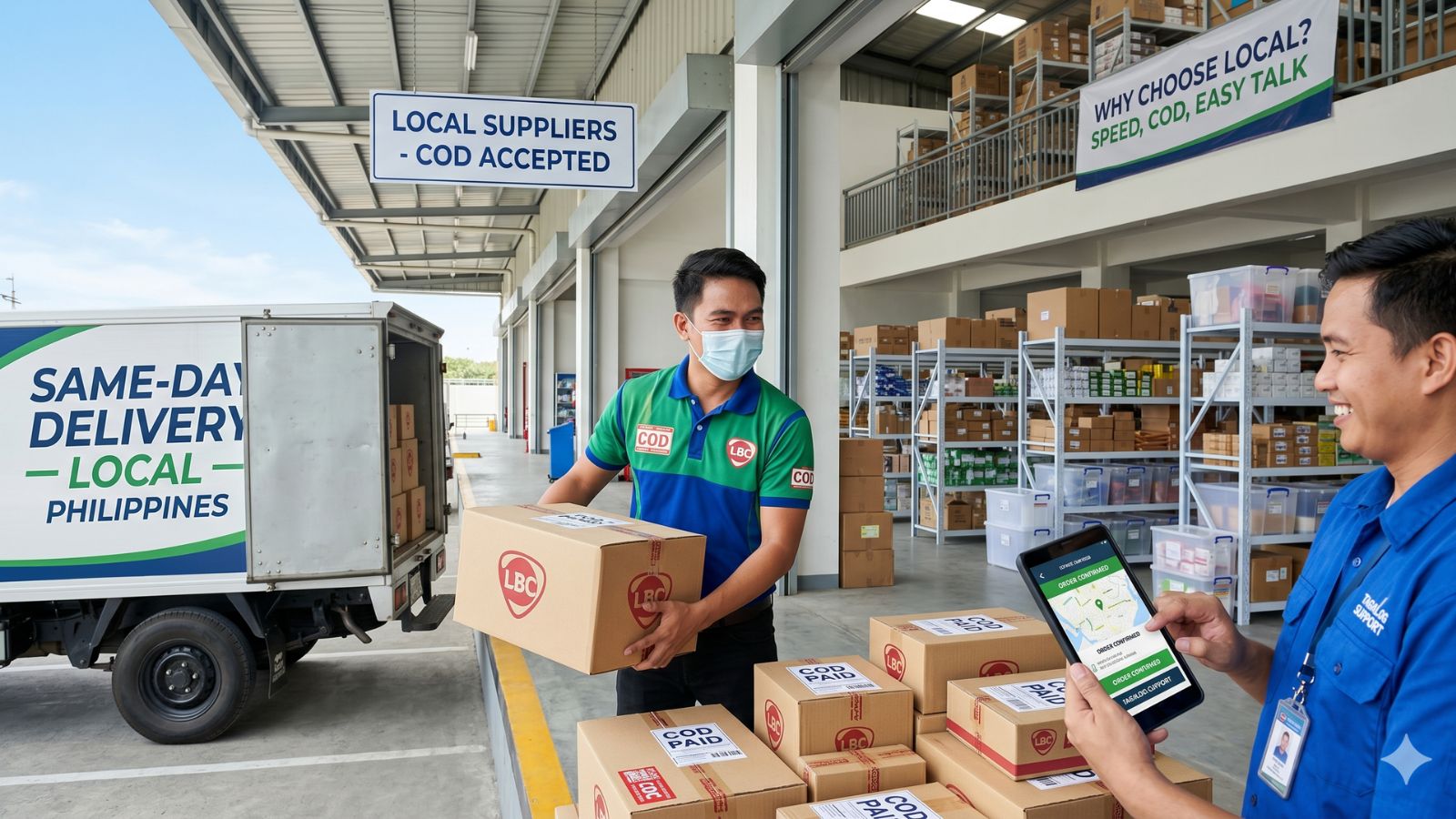
Are you tired of supplier lists that never work? Most guides give you a list of names. None of them tell you why most dropshippers in the Philippines fail.
Finding dropshipping suppliers in the Philippines is not your real problem. The real problem is picking the wrong supply model. Local suppliers have speed advantages, but Chinese fulfillment partners offer wider product range, lower costs, and full customization. The right choice depends on your product strategy.
I have worked with dozens of dropshippers across Southeast Asia. The ones who fail in the Philippines almost always make the same mistakes. They obsess over supplier lists. They never fix their actual model. In this post, I will walk you through five hard truths about dropshipping suppliers in the Philippines, and then show you a strategy that actually works.
Are Most Philippines Dropshipping Suppliers Actually Real Manufacturers?
You search "dropshipping suppliers Philippines" and you get a long list. You feel excited. You message a few of them. Then you realize something strange. Their prices are not much lower than Lazada retail prices. Their product photos look like they were copied from somewhere else. They tell you minimum orders are "just 1 unit," but delivery takes longer than expected.
Most "Philippines dropshipping suppliers" are not manufacturers. They are resellers or middlemen who buy from Lazada, Shopee, or Chinese wholesale platforms and mark up the price. You are buying from a middle layer, not the source. This directly reduces your margins and limits your control.
This is not a criticism. Middlemen exist because there is demand. But you need to understand what you are actually buying into. When you source from a middleman, you face three specific problems.
Why Does the Middleman Layer Hurt You?
| Problem | What It Means for You |
|---|---|
| Thin Margins | You pay near-retail prices and can barely mark up for profit |
| No Product Control | You cannot request changes, custom packaging, or branding |
| Stock Instability | If their supplier runs out, you run out |
| Slow Dispute Resolution | Middlemen cannot fix factory-level quality problems |
Here is a real scenario I see often. A seller finds a "supplier" in Manila who offers phone accessories. The pricing looks OK. They start selling. Then one batch arrives with bad packaging. They contact the supplier. The supplier says "we will check." Two weeks pass. No fix. Why? Because the supplier is also waiting on their own supplier. You are two layers away from the source. Every problem takes twice as long to solve. This is why I always tell people: before you work with any supplier, ask one question. "Do you make this product yourself, or do you buy it?" The honest ones will tell you. The answer will change everything about how you plan your business.
Is Your Real Competition Local Sellers or Chinese Sellers Shipping Directly to the Philippines?
Most new dropshippers in the Philippines think their competition is other local sellers. They try to undercut local prices by a few pesos. They think that is the game.
Your biggest competition in the Philippines dropshipping market is not local sellers. It is Chinese sellers who ship directly from China to Filipino buyers through Shopee, Lazada, and TikTok Shop. They have factory-direct pricing, massive product range, and aggressive shipping subsidies that local resellers cannot match.
This changes how you need to think about your entire strategy. You cannot win on price alone against a seller who buys directly from a factory in Guangzhou. You will always lose that fight. But that does not mean you cannot win in the Philippines market. It means you need to stop fighting on their terms.
How Chinese Direct Sellers Dominate on Price
| Faktor | Chinese Direct Seller | Local Philippines Reseller |
|---|---|---|
| Cost Source | Factory direct | Buys from wholesaler or Lazada |
| Platform Subsidy | Often subsidized shipping | Pays full local shipping rates |
| Product Breadth | Thousands of SKUs | Limited to what local stock has |
| Branding | Generic, no packaging | Slightly better but still basic |
| Speed to Philippines | 7–14 days via Cainiao or similar | 1–3 days locally |
The speed gap is the only real advantage local sellers have. And it matters for some products. But in most product categories, Filipino buyers on Shopee and Lazada will wait a week to save ₱200. That is just the market reality. I am not saying this to discourage you. I am saying this because once you accept it, you stop competing on price and start competing on value. That is where you can actually win.
Are Local Suppliers Fast Enough to Make Up for Their Other Weaknesses?
Speed is real. When a local Philippines supplier ships an order, your buyer gets it in one to three days. That feels great. It reduces complaints. It helps with COD collection rates. I understand why this is attractive.
Local Philippines suppliers do offer faster domestic shipping. But their product range is narrow, customization is almost impossible, and pricing is rarely competitive. Speed is a real advantage, but it only applies to certain product types and customer expectations.
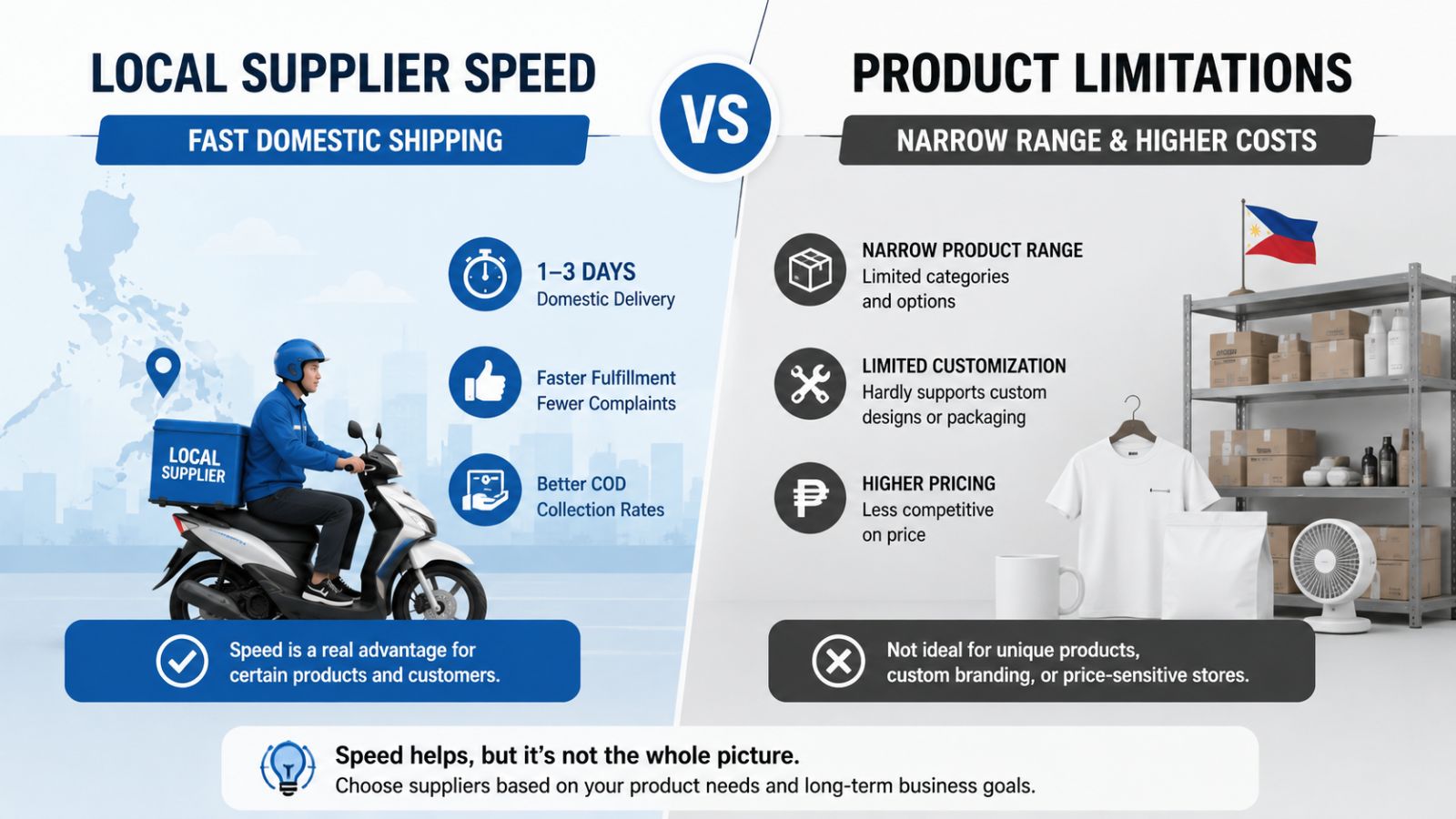
So when does local supplier speed actually matter? And when does it not? Let me break this down with clear scenarios.
When Local Speed Matters vs. When It Does Not
| Scenario | Does Local Speed Help? | Warum |
|---|---|---|
| COD orders for impulse buys | Ja | Faster delivery = lower refusal rate |
| Branded or niche products | Nein | Local suppliers rarely carry these |
| Custom packaging or logo | Nein | Local suppliers almost never offer this |
| High-volume seasonal products | Nein | Local stock runs out fast |
| Low-price, high-competition items | Nein | Cannot compete on cost against China-sourced products |
Here is what I see regularly. A dropshipper picks a local supplier because of fast delivery. Everything works for the first few weeks. Then they want to expand their product line. The local supplier does not have what they need. They want to add custom packaging for their brand. The supplier says no. They want better pricing as volume grows. The supplier cannot offer it. Speed got them started. But speed alone cannot grow a business. At some point, product range, cost, and customization will matter more than next-day delivery. That is the moment most dropshippers realize they built their business on a foundation that cannot scale.
What Are the Real Pros of Using Local Philippines Dropshipping Suppliers?
I want to be fair here. Local suppliers are not a bad choice in all situations. There are specific cases where they are genuinely the better option.
Local Philippines dropshipping suppliers offer real advantages in speed, COD compatibility, and lower communication barriers. For certain product types and business stages, they are the practical choice. The key is knowing when their strengths match your needs.
Here are the genuine strengths that local suppliers bring to the table.
Genuine Advantages of Local Philippines Suppliers
| Advantage | Warum es wichtig ist |
|---|---|
| Fast Domestic Delivery | 1–3 days reduces COD refusal and buyer complaints |
| Tagalog / Filipino Communication | Easier coordination, fewer misunderstandings |
| COD-Ready Logistics | Many are already plugged into J&T, Ninja Van, Flash Express |
| No Import Customs Risk | Products are already in the country |
| Niedriges MOQ | Easy to start with small test orders |
| Simple Returns | Easier to handle local returns and exchanges |
If you are just starting out and want to test a product idea with low risk, a local supplier makes sense. You do not need to import anything. You do not need to invest in inventory. You can test the market in weeks, not months. That is real value. I always tell beginners: use local suppliers to validate. Once you know what sells, then you build the supply chain that actually scales.
Do Successful Philippines Dropshippers Sell Generic Products or Differentiated Ones?
Look at the top sellers in any niche on Shopee Philippines. Now look at what they are actually selling. It is rarely the cheapest generic product. It is almost always a product with a story, a brand name, better packaging, or a specific use case that speaks to a Filipino buyer.
Successful dropshippers in the Philippines do not compete on generic products. They win by finding a specific niche, building a simple brand identity, and using custom packaging or product bundles to stand out. Generic products are a race to the bottom. Differentiation is where profit lives.
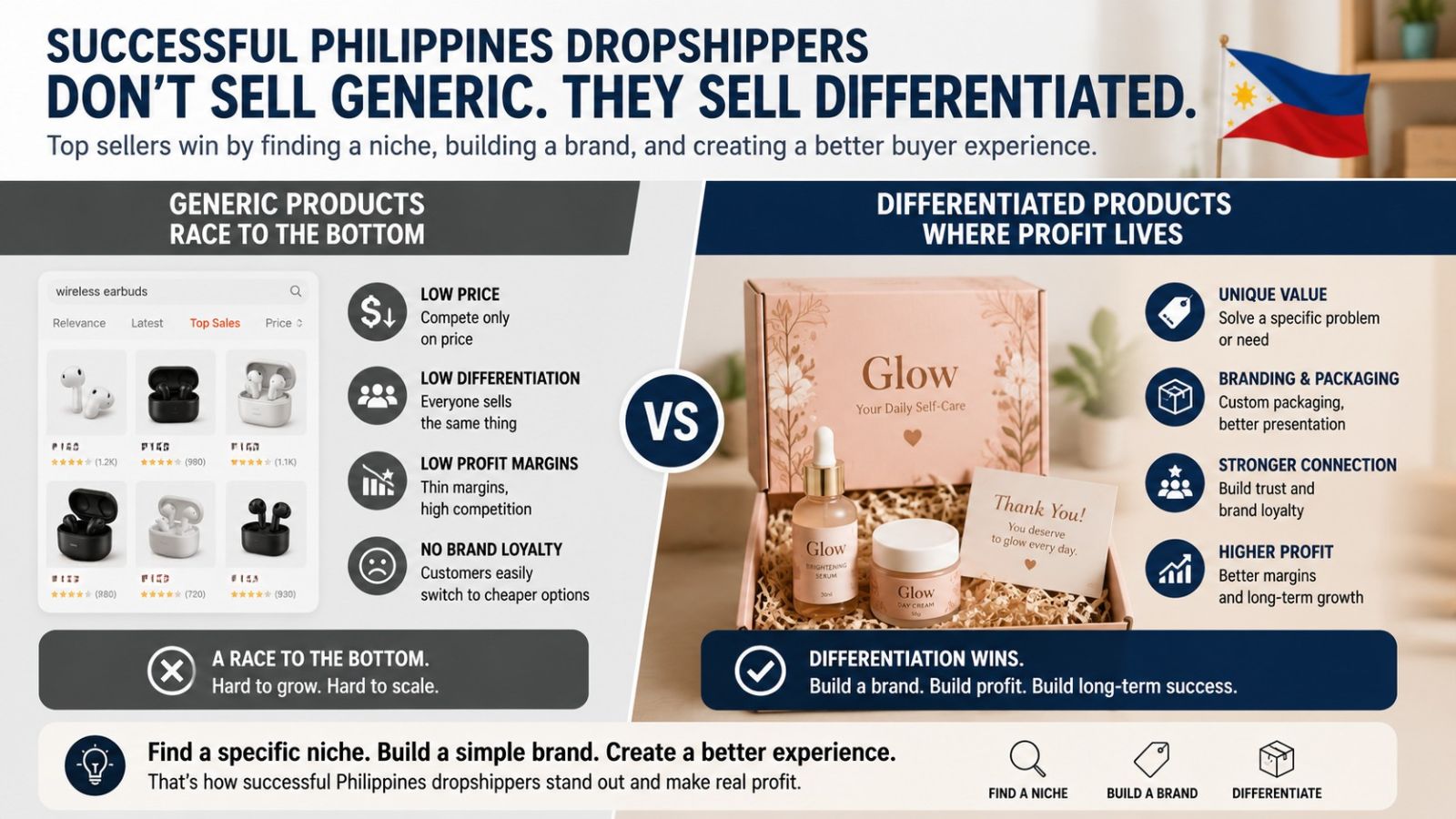
This is the single biggest mental shift I want you to make. Stop looking for hot products. Start looking for an underserved buyer. Here is how differentiation works in practice.
How Differentiation Changes Your Dropshipping Business
| Strategie | Generic Approach | Differentiated Approach |
|---|---|---|
| Product Selection | Copy what is trending | Find what a specific group needs |
| Packaging | Plain brown box | Branded box with thank-you card |
| Pricing Power | Forced to match lowest price | Can price 20–40% higher |
| Customer Loyalty | Zero, buyers go where it is cheapest | Higher repeat purchase rate |
| Supplier Requirement | Any local middleman works | Need a fulfillment partner who supports customization |
Here is a concrete example. Two sellers both sell posture correctors in the Philippines. Seller A buys from a local middleman, ships in a plain poly bag, and sells for ₱299. Seller B sources from a China fulfillment partner, adds custom packaging with Filipino language instructions, includes a small card about back health, and sells for ₱499. Seller B has fewer sales but makes more profit per order and builds repeat buyers. Seller A is in a price war they cannot win. The product is almost identical. The experience is completely different. That difference comes from your supply chain choices, not just your marketing.
Does COD in the Philippines Mean You Can Only Use Local Suppliers?
COD is a real constraint in the Philippines. A large portion of Filipino online shoppers still pay on delivery. This makes many dropshippers believe they must use local suppliers. Because local means fast. And fast means lower COD refusal rates.
COD is a real market condition in the Philippines, but it does not lock you into using only local suppliers. Chinese fulfillment partners with fast shipping lines to the Philippines can deliver in 5–8 days, which is fast enough for most COD orders. The key is choosing the right logistics channel, not just the nearest supplier.
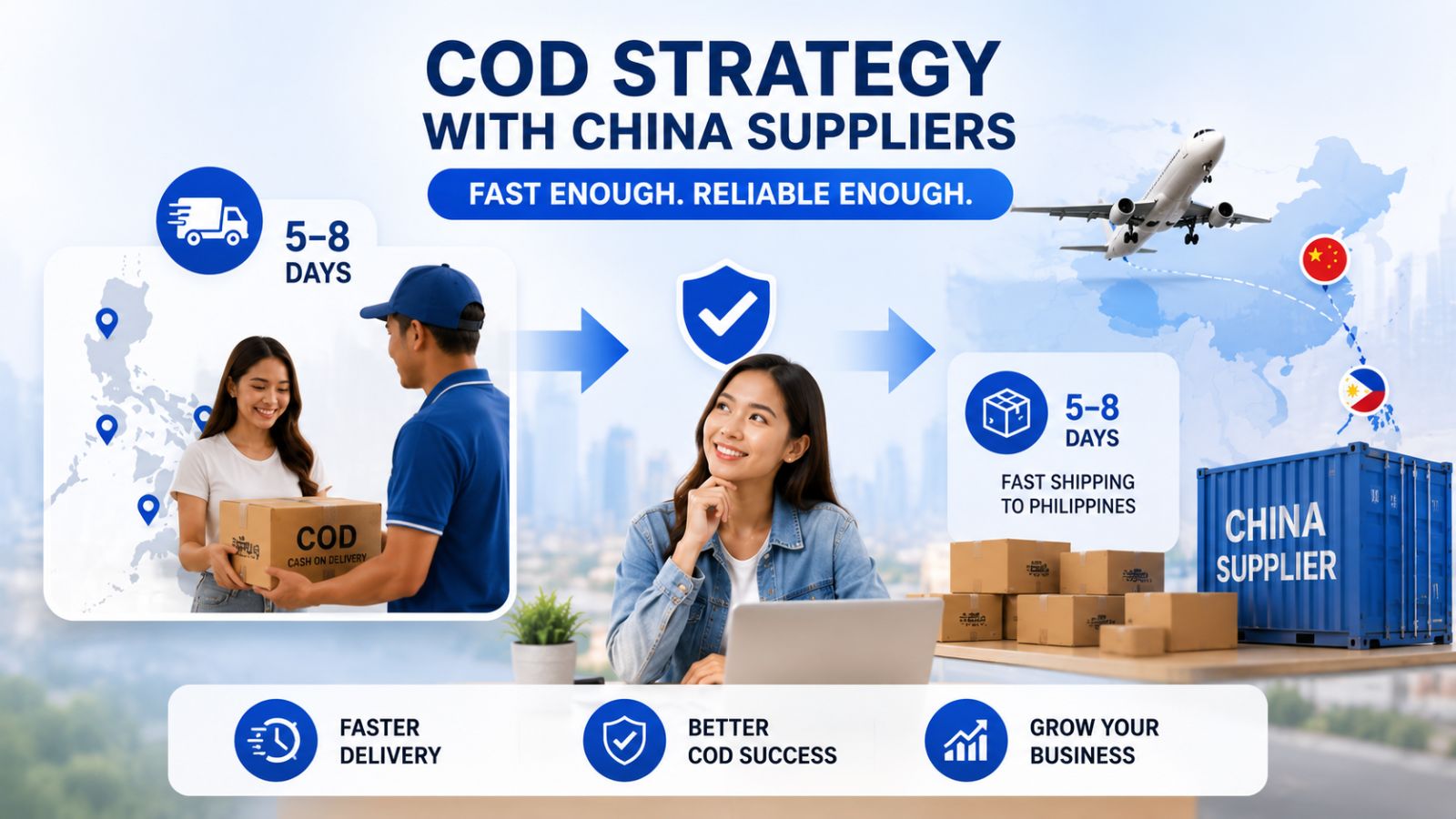
Let me show you how this actually works in a real fulfillment flow.
COD-Compatible Fulfillment Flow Using a China-Based Partner
| Step | What Happens |
|---|---|
| 1. Order Placed | Buyer places COD order on your Shopify or TikTok store |
| 2. Auto-Sync | Order syncs to your fulfillment partner via ERP integration |
| 3. Pick & Pack | Partner picks the product, applies your custom packaging |
| 4. Ships via Fast Line | Uses a Philippines-specific fast lane (e.g., 5–8 day tracked shipping) |
| 5. Last Mile | Handed to J&T, Ninja Van, or Flash Express for local delivery |
| 6. COD Collected | Courier collects cash on delivery |
| 7. Remittance | Cash remitted back to you by courier platform |
This process works. It is not as fast as a local supplier shipping from Cebu or Mandaluyong. But 5–8 days is not slow. For most product categories, a Filipino buyer who ordered something they actually want will wait 7 days. The refusal rate goes up when buyers forget they ordered, when delivery is unclear, or when the product does not match expectations. Those are marketing and product problems. Not shipping speed problems. A fulfillment partner who gives you tracking, branded packaging, and quality control will reduce COD refusals more than a local supplier who ships fast in a plain bag.
So What Is the Smart Strategy for Dropshipping in the Philippines?
You now know the truths. Local suppliers are mostly middlemen. Your real competition ships from China. Speed alone does not scale your business. COD does not trap you with local suppliers. And generic products will kill your margins.
The smart strategy for dropshipping in the Philippines combines local supplier testing with a China-based fulfillment partner for scaling. Test with local. Validate demand. Then switch to a fulfillment partner who offers sourcing, custom packaging, quality control, and fast Philippines shipping lines.
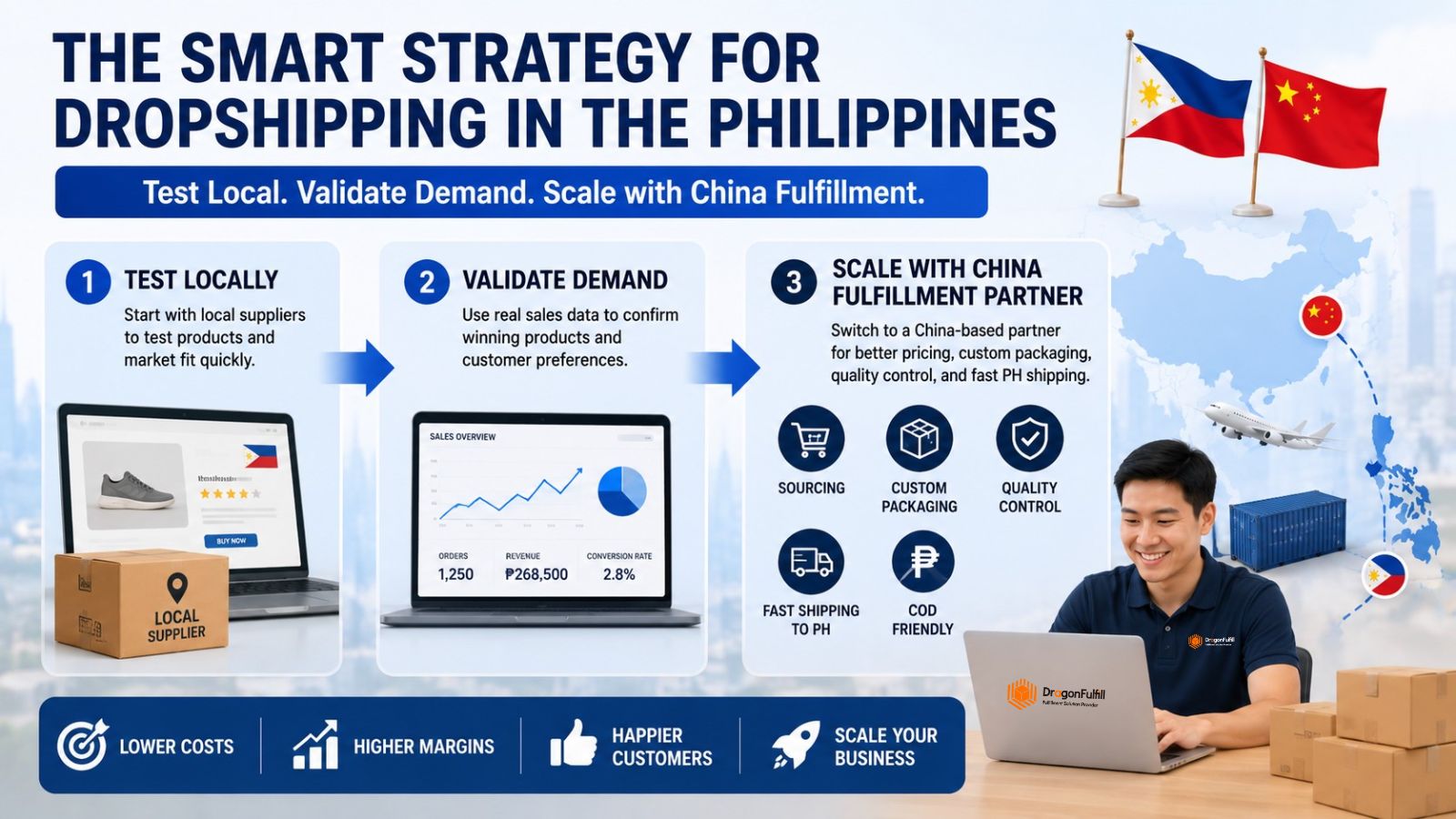
Here is how I would build this step by step.
A Two-Phase Philippines Dropshipping Strategy
| Phase | What You Do | Warum |
|---|---|---|
| Phase 1: Validate | Use local suppliers to test 3–5 product ideas | Low risk, fast feedback, no import needed |
| Phase 1: Measure | Track conversion rate, COD refusal rate, and profit per order | Data beats guessing |
| Phase 2: Source | Find a China fulfillment partner for your winning product | Lower cost, more control, better packaging |
| Phase 2: Differentiate | Add custom packaging, brand name, and product-specific inserts | Builds brand equity and raises perceived value |
| Phase 2: Scale | Use ERP integration with Shopify or TikTok Shop | Automates orders and reduces manual work |
| Ongoing | Keep monitoring shipping speed and quality | Adjust logistics channel as volume grows |
At DragonFulfill, we work with dropshippers who are at exactly this second phase. They have already tested a product. They know it sells. Now they need a partner who can source it from a factory, package it with their brand, and ship it to Filipino buyers in a way that supports COD workflows. That is what a full-chain fulfillment partner does. It is not just shipping. It is sourcing, quality inspection, packaging, and logistics working as one system.
What Are the Most Common Mistakes When Looking for Dropshipping Suppliers in the Philippines?
Most dropshippers who fail in the Philippines do not fail because they picked the wrong supplier. They fail because they used the wrong model from the start.
The most common mistakes when looking for dropshipping suppliers in the Philippines include chasing supplier lists instead of fixing the business model, competing on price with generic products, and ignoring the role of branding and fulfillment infrastructure in long-term profit.
Let me walk through the specific mistakes I see most often.
Most Common Dropshipping Mistakes in the Philippines
| Mistake | What It Looks Like | What to Do Instead |
|---|---|---|
| Chasing Supplier Lists | Downloading 50-supplier PDFs and never testing one | Test 1–2 products with 1 supplier first |
| Competing on Price | Selling the same product as 100 others for ₱10 less | Pick a niche and add product value |
| Ignoring COD Refusal Causes | Blaming shipping when buyers refuse | Fix your product description and expectation-setting |
| No Brand Identity | Plain packaging, no store name, no story | Even a simple logo and thank-you card matters |
| Skipping Quality Control | Shipping without checking the product | Use a fulfillment partner who includes inspection |
| Not Tracking Metrics | Not knowing profit per order or refusal rate | Set up basic tracking from day one |
| Scaling Too Fast | Ordering 500 units before validating | Validate with 10–20 orders first |
I want to highlight one mistake that I think is the most damaging. It is the belief that more supplier options will fix the business. I have seen dropshippers spend three months researching suppliers. They build a spreadsheet with 80 names. They never send a single test order. Research feels productive. But it is not selling. Your first real lesson in dropshipping comes from your first real order, not your longest supplier list.
The Truth About Dropshipping Suppliers in the Philippines Is Simple
Stop chasing supplier lists. Start building the right model. Test local, validate demand, then scale with a fulfillment partner who gives you sourcing, branding, and reliable Philippines shipping in one place.
If you are ready to move from testing to scaling, DragonFulfill offers end-to-end dropshipping fulfillment with custom packaging, quality inspection, and fast shipping lines to the Philippines. Get in touch with us today and let us help you build a dropshipping business that actually works.

 English
 Spanish
 Portuguese
 Russian
 German
 Polish